Showing posts with label Alice Ziplinsky's sense of her own moral superiority. Show all posts

Wednesday, July 14, 2010

It Probably Seemed Like a Good Idea at the Time


Maybe this was the thinking:

Miley Cyrus, popular with kids, check.

Candy, popular with kids, check.

Hannah Montana Candy, genius!

Candy should be in the shape of a guitar, why not?

Candy should be flesh colored, okay, sure. BAD, BAD, IDEA!

Alice Ziplinsky made some serious miscalculations with some of her candy lines, but nothing was this bad. I regret that she didn't make mention of this product in defense of her Little Susies.

Saturday, July 3, 2010

Is There a 4th of July Candy Tradition? No There is Not.


Candy is associated with many American holidays, but to the eternal sorrow and frustration of the candy industry, there is nothing really indelible about the 4th of July, candy-wise. The Hershey's people have been brilliant in recent years about cross-marketing the Hershey Bar with Nabisco Graham Crackers and Kraft Jet-Puffed Marshmallows for some s'mores end cap and bin displays in supermarkets, but that's really about it. (See page 42 of True Confections for Alice Ziplinsky's views on this subject.) Most efforts to grab some 4th of July dollars from supermarket shoppers consist of feeble seasonal cellophane wrappers on boxes, but even then, what is the symbol for the 4th of July? Christmas is a tree or an ornament, Valentine's Day is a heart, but what is the 4th of July? Red white and blue, the American flag. Maybe there are some compelling patriotic jelly bean mixes out there. But red, white and blue and the flag are also symbols for Memorial Day, Veteran's Day, and also other [problematic to many of us] patriotic endeavors like "supporting" our troops, depending on context.


One company that has tried harder than most to corner the 4th of July candy dollar is Tootsie. But the flag labels don't convince me that Tootsie Rolls are a traditional element of the day, and I doubt that shoppers will ever make their lists for their 4th of July cookout or picnic so that right after hot dogs, hamburger, buns, ketchup, pickles, chips, anyone is going to write Tootsie Roll Midgees. But nice try, Tootsie!

Tuesday, June 22, 2010

On a Scale of One to Ten:


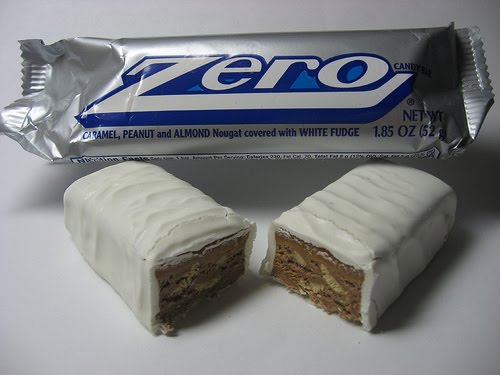
A candy bar composed of caramel, peanut and almond nougat (so far, so good and also so universal), covered with...delicious white fudge. Hmm. Make that "delicious white fudge," you ingredient swapper-outers at Hershey's. How the Zero Bar has surived since 1920 (or 1931, depending on where you find this product history) is a bit of a mystery, though it is probable that when it was first produced by Hollywood Brands of Centralia, Illinois, it really was made with actual delicious white fudge.


Have you tasted one of these? I finally tried one for the first time at the Sweets & Snacks Expo last month. Very groovy graphics aside (and graphics do count for something), the vile chemical fakeness is quite extreme. I've had more delicious spackle. If this were a new product launch instead of a retro line that has been sold down the river repeatedly (Hollywood was sold to Consolidated Foods/Sara Lee, which sold it to the Finnish company H. Oy, owners of Leaf candy brands in the U.S., which was sold to Hershey's in 1996), it would never have survived. Or been developed in the first place.


If they were launching this bar today and trying to come up with a name for it, it would be obvious how they had arrived at the name Zero: focus groups asked to taste it and rate the flavor on a scale of one to ten would have been the inspiration. Alice Ziplinsky, worshipper of Green & Black's White Chocolate, would have had a great deal of scorn for this "delicious white fudge."

Thursday, June 17, 2010

Does a Gummy Army Travel On Its Stomach?


My unscientific yet thorough in its own way analysis of candy preferences tells me that devotion to gummy candy is an overwhelmingly female trait. Maybe the gummy candy people think so too. Why else would they have produced Green Gummy Army Guys? Now you can crawl around in the backyard and have your bloodthirsty war games and eat them too! Surely Alice Ziplinsky would have deplored and also admired this product.

Monday, May 31, 2010

Tastes Like Red!


I am just back from the fabulous 2010 Sweets & Snacks Expo in Chicago -- the largest candy trade show in the Americas -- and one of the many exciting things I discovered there (while experiencing the three days as a complex sort of deja vu, given the scenes in True Confections that take place at this show, where this year I was signing books in the Candy Industry Magazine booth) was that America's favorite flavor is "red." Cherry, strawberry, whatever -- so long as it's red. This is why one of the dominant new flavors popping up across a range of familiar products is pomegranate. And then there's the just-released variation of Just Born's Mike and Ike -- Red Rageous, a mix of red flavors (grape, raspberry, cherry, strawberry, melon). If Alice Ziplinsky had known that most people think their favorite flavor is red, she would have had something to say about that in the pages of True Confections.

Sunday, May 16, 2010

The Hershey Train


Why didn't I include a reference in True Confections to Milton S. Hershey's train, still functioning in Cuba today? In 1927, Hershey, having first established his own sugar refining source in Cuba in order to avoid being at the mercy of fluctuating sugar prices, built his own train line that crossed the island, making it possible for workers to travel easily to the Hershey sugar cane factory, and to transport the sugar back to the harbor, for export to his chocolate manufacturing plant in Hershey, Pa.


Hershey was an extraordinarily thoughtful, idealistic, humanitarian, and also very, very practical businessman. He decided to locate his sugar refining operation in the province of Matanzas because he believed its higher elevation was a healthier (and therefore more productive) location. Hershey constructed a small village near his sugar cane plantation, rows of workers’ cottages with front porches and tile roofs. Unlike most sugar plantations, the Hershey operation paid weekly wages, instead of hiring and firing workers seasonally. The Hershey village had a medical clinic and grocery store, and he provided this little worker community with a school, complete with playground, and its own power plant generating electricity, as well as sewers and a water supply. All of this was in the name of productivity, but there was also a fascinating and admirable humanitarian intention manifest in this way of doing business.

Milton Hershey guessed wrong about the longterm stability of Cuba when he chose his sugar plantation location for its proximity to the U.S., and when Castro came to power in 1959, Hershey enterprises were closed down. Today the plantation is a jungle, and the workers' village is a ghost town, but the train still runs. Alice Ziplinksy would have had something to say about this, probably an identification with Hershey's good intentions being thwarted.

Sunday, May 9, 2010

I forgot the bris!


Why wasn't there a ritual circumcision for Jacob Ziplinsky in True Confections, complete with a contentious Ziplinsky family gathering and a chopped chicken liver centerpiece? How could I have overlooked this opportunity for Alice Ziplinsky to report on, mock, analyze, and feel superior to this particular Ziplinsky family custom? Rats.

Tuesday, March 2, 2010

Black Jack, Anyone?


The long association through much of the 20th century between candy and other comestibles and quaint depictions of black people is rich and cringey. Here, for example, we see the long lost cousin of the Clark Bar. Anything made with licorice or chocolate lent itself especially easily to this dimwitted and popular marketing strategy over the decades. Why this brand of caramels qualified for minstrel status is less clear. Over 69 years of progress? What does that mean? Caramel progress, minstrel progress, D.L. Clark Candy Company progress? In any case, if I had known of this brand I would have had Alice Ziplinsky mention it in her tirade about Negro imagery in candy and food advertising in the pages of True Confections.

Saturday, January 30, 2010

Candy Failure


In True Confections, Alice makes more than one terrible mistake with candy products. She takes responsibility for neither the Bereavemints fiasco nor the regrettable packaging decisions about Little Susies. Had I glimpsed this ill-conceived gumball machine while I was writing the novel, Alice would have mentioned it as an example of mistakes made by others.